The science
The Issue
What actually happens to a balloon after you let it go – and why the answer has been so hard to find.
In a nutshell
A released balloon does not disappear. It becomes a jellyfish.
Rubber Jellyfish reveals the shocking jellyfish-like shapes that balloons burst into when they are released into the air, and how this is affecting sea turtles who mistake these items for prey. We also explore the balloon industry greenwashing that kept this phenomenon a secret for decades.
Three numbers worth knowing
- 6 of 7 sea turtle species worldwide are endangered, according to the IUCN Red List
- 78% of all rubber items found inside deceased sea turtles were balloons or balloon fragments
- 12 months in seawater, and the latex balloons in a 1988 US government study were still intact
Quick facts
Every claim below is drawn from published research or an official source. The links go to the primary material, not to a summary of it.
- Six of the world’s seven sea turtle species are endangered, according to the IUCN Red List.
- A 2012 University of Queensland study found that balloons were disproportionately consumed by sea turtles relative to how common balloons are as litter on Queensland beaches – in other words, sea turtles specifically target them. Of all rubber items found inside deceased sea turtles, 78% were balloons or balloon fragments. The researchers concluded this was because of their resemblance to jellyfish, a prey species all sea turtles eat. Read the paper.
- When helium balloons are released, many burst into jellyfish-like shapes high in the Earth’s atmosphere. The trailer shows what this looks like.
- Sea turtles cannot vomit, so ingesting human rubbish is particularly dangerous for them – what goes in cannot come back out.
- Ingesting balloons and plastic can cause ‘float syndrome’: gases form in the digestive tract around the swallowed rubbish, and the animal can no longer dive. Floating leaves it exposed to boat strike, shark predation, barnacle accumulation and sunburn, and unable to reach food or shelter. Many die slowly of starvation.
- Balloons also cause choking and entanglement deaths in species other than sea turtles, including numerous sea birds, birds of prey, whales, bighorn sheep, horses, lambs, seals and platypuses.
- In most parts of the world, balloon release ceremonies are legal. They are a popular way of memorialising a lost loved one.
- Since the late 1980s, latex balloons have been labelled “100% biodegradable and environmentally friendly” – a claim that has contributed to the popularity of balloon releases.
- According to the US Consumer Product Safety Commission, “of all children’s products, balloons are the leading cause of suffocation death”.
- Helium inhalation can also be fatal. Helium suppliers themselves warn consumers about the dangers of inhaling their product.
Greenwashing
The “100% biodegradable” claim
The balloon industry has told consumers since the 1980s that latex balloons break down about as quickly as an oak leaf. That comparison is the reason so many people believe a released balloon is harmless.
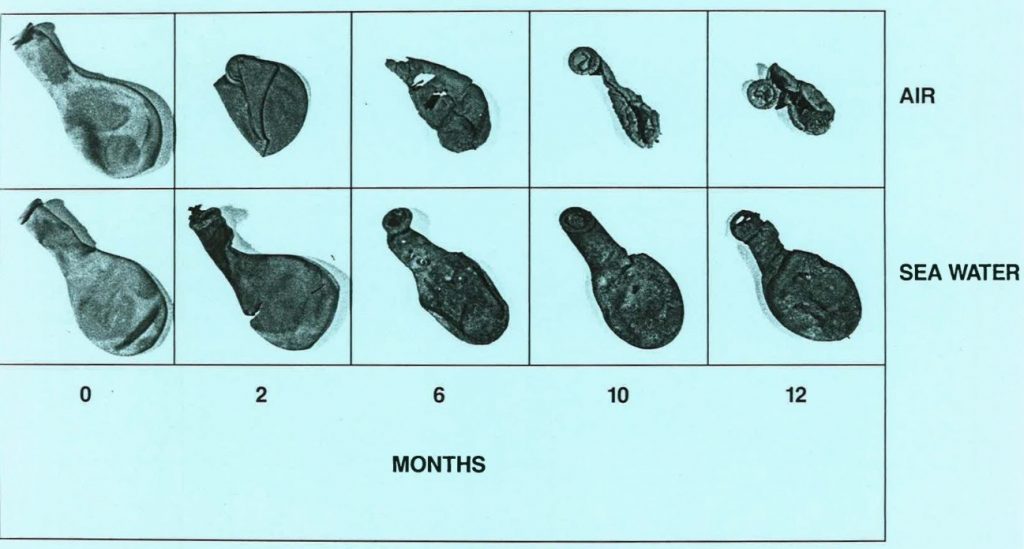
It does not survive contact with the research. In a 1988 study for the US National Marine Fisheries Service, balloon samples were floated in continuously circulated seawater at a beach and examined every two months. After twelve months, the latex balloons were still intact.
The image alongside is that study’s own comparison: the top row is latex left in open air, the bottom row the same latex immersed in salt water, photographed at zero, two, six, ten and twelve months.
Where to read more
Organisations working on balloon litter and marine debris, and the campaigns worth following.
Be a change maker
Knowing this is the first step. Three local governments have banned balloon releases because somebody put these facts in front of the people who could act on them.
Find out how to help See what has changed so far
There are also resources for teachers, and a press kit for journalists and bloggers.